
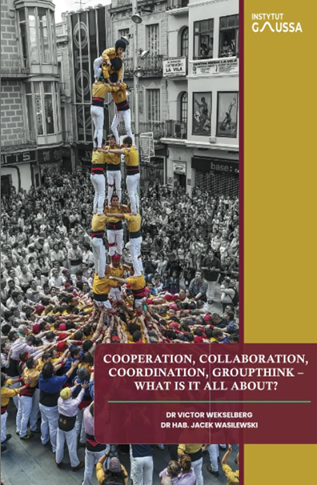
Cooperation, collaboration, coordination, groupthink – what is it all about?
What makes cooperation different from simply working together?
Victor Wekselberg and Jacek Wasilewski examine cooperation as a complex social process rather than a convenient label for any activity performed by more than one person.
The book distinguishes cooperation from information exchange, coordination and groupthink. It explains why aligned goals, appropriate attitudes, relevant competences and well-designed relationships between people are necessary if a group is to use its full potential.
The central question
What is cooperation? Doing something at the same time or inside the same organization does not necessarily constitute cooperation. The authors invite readers to examine what must happen between people for their efforts to create a result that none of them could produce alone.
Cooperation, coordination and groupthink
Coordination organizes tasks and dependencies. Cooperation additionally requires people to take one another’s actions into account, exchange relevant knowledge and adjust their behaviour as circumstances change. Groupthink, by contrast, can suppress critical perspectives and create the appearance of agreement without improving the quality of decisions.
What will you learn?
- how to distinguish cooperation from information exchange and task coordination;
- why aligned goals matter and how relationships between goals can support or obstruct joint action;
- how attitudes and competences influence a team’s ability to use individual contributions;
- why a group of talented people does not automatically become an effective team;
- how cooperation affects innovation, conflict resolution, public institutions and team sports.
Who is this book for?
- managers and team leaders;
- business owners and organizational decision-makers;
- HR professionals, consultants and educators;
- people working in public institutions and non-governmental organizations;
- anyone looking for a precise, practical language for discussing cooperation.
A short book with a practical purpose
The authors use concise explanations and examples to make a complex subject accessible. Their aim is not to offer a motivational slogan, but to help readers diagnose what is missing when people are expected to cooperate and results remain disappointing.
About the authors
Victor Wekselberg contributes the perspective of organizational psychology, research and decades of consulting practice. Jacek Wasilewski brings expertise in language, communication and narrative. Together they connect behavioural knowledge with the way people describe, negotiate and organize collective action.
Book information
- Title: Cooperation, collaboration, coordination, groupthink – what is it all about?
- Authors: Victor Wekselberg and Jacek Wasilewski
- Language: English
- Availability: Amazon
Frequently asked questions
Is cooperation the same as teamwork?
Not necessarily. A team may divide and coordinate tasks without creating the relationships, mutual adjustment and exchange of knowledge required for genuine cooperation.
Does cooperation require everyone to agree?
No. Cooperation does not eliminate differences or critical discussion. It requires people to use those differences while working toward aligned goals.
Is the book relevant outside business?
Yes. Its examples and conclusions apply to public administration, local government, non-governmental organizations, education, social conflicts and team sports.
Discuss cooperation in your organization
We help leaders and teams diagnose barriers to cooperation and translate psychological knowledge into practical organizational solutions.