Organizational psychology grounded in evidence and practice
The Gauss Institute helps owners, boards and managers understand why an organization is not working as effectively as it could — and what needs to change in people, roles, decisions or processes.
We combine organizational psychology, research, business data and direct observation of work. Our recommendations are designed to be implemented in real organizations, not left in a presentation.
The Gauss Institute
Our name refers to Carl Friedrich Gauss and to a way of thinking that values measurement, probability and disciplined reasoning. We use data and advanced analytical methods to test assumptions about organizations, teams and individuals.
At the same time, numbers never replace context. Organizational performance depends on the relationships between people, goals, roles, competencies, motivation and working conditions. This is why we examine the system as a whole before recommending an intervention.
Our working principles
- begin with the business question, not with a standard product;
- separate observable evidence from interpretation;
- consider people and organizational conditions together;
- translate diagnosis into decisions and practical implementation;
- review outcomes and revise assumptions when the evidence changes.
Meet the team
We work directly with clients. The people who diagnose the challenge also take part in designing and implementing the solution.

Darek Ambroziak
Darek is an organizational psychologist and managing director of the Gauss Institute. For more than twenty years he has worked with owners, boards and managers on organizational performance, leadership development, cooperation and evidence-based people decisions.
He is particularly interested in individual work with senior managers and in changes that connect personal development with a real business challenge.

Dr Victor Wekselberg
Victor is an organizational psychologist with more than forty years of research and consulting experience. He develops original concepts concerning cooperation, motivation and the functioning of organizations, teams and individuals.
His work connects scientific rigour with questions managers face in practice: how people respond to goals, why cooperation fails and what enables an organization to use its human potential.
How we understand organizational performance
People in context
A person’s effectiveness cannot be explained by one trait or score. Role requirements, motivation, competencies, relationships and organizational conditions matter together.
Aligned goals
Activity is not the same as progress. We examine whether personal, team and organizational goals are aligned and whether everyday decisions support them.
Cooperation as a system
Cooperation requires more than good intentions. It depends on information, trust, attitudes, competencies, goal relationships and the way work is organized.
Behaviour that can change
We distinguish relatively stable characteristics from behaviours that can be developed, enabling more realistic development decisions.
Evidence and judgement
Data improves decisions when it is interpreted in context. We combine measurement with professional judgement instead of treating either as sufficient on its own.
Implementation in real work
Development becomes valuable when managers use new behaviour to solve actual organizational problems and improve decisions.
Books and publications
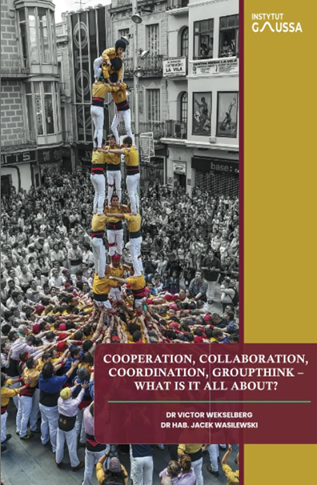
Cooperation, collaboration, coordination, groupthink — what is it all about?
Victor Wekselberg and Jacek Wasilewski explain the differences between cooperation, coordination and groupthink, and show what enables people to use their individual contributions effectively.

Pięć wymiarów człowieka
Darek Ambroziak, Victor Wekselberg and Jacek Wasilewski present five dimensions that help explain behaviour at work: temperament, personality, work motivation, behavioural competencies and influence tactics.
Let us look at the real problem together
If you are facing a leadership, cooperation, strategy or organizational design challenge, we can help you identify what is happening and what evidence would support the next decision.
